
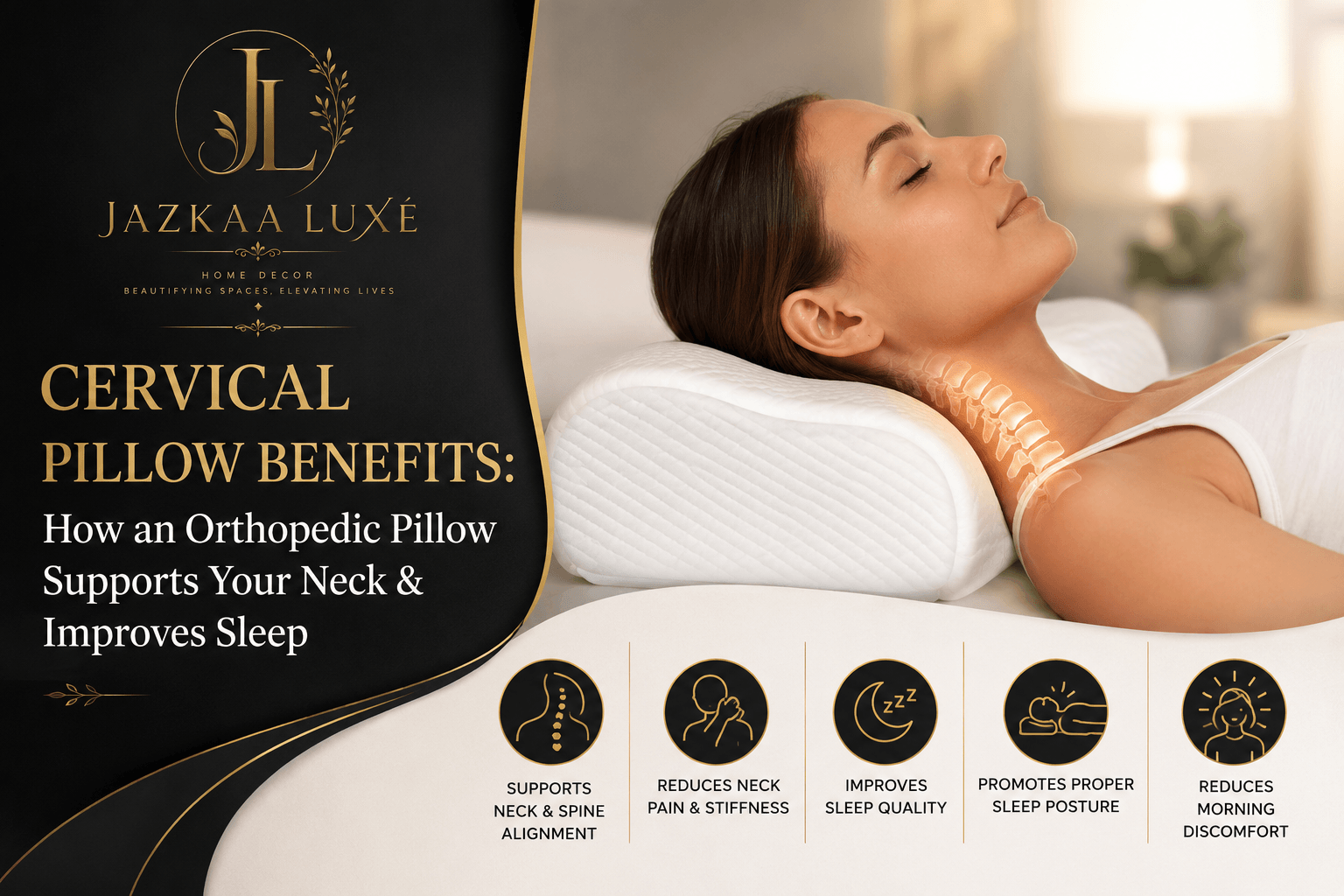
Cervical Pillow Benefits: How an Orthopedic Pillow Supports Your Neck & Improves Sleep
Waking up with a stiff neck, shoulder discomfort, or a feeling that you did not sleep properly can sometimes be related to your sleeping posture and pillow support. The pillow you use every night plays an important role in keeping your head and neck comfortable while you sleep.
A cervical pillow, also known as an orthopedic pillow or neck support pillow, is designed to provide targeted support to the neck while helping maintain a more natural alignment of the head, neck, and spine. Unlike a traditional flat pillow, many cervical pillows feature a contoured shape that supports the neck and cradles the head.
Choosing the right pillow can make your bedtime routine more comfortable and may help promote better sleeping posture. However, the ideal pillow depends on factors such as your sleeping position, mattress firmness, pillow height, body shape, and personal comfort.
In this guide, let’s explore the benefits of cervical pillows, how cervical pillows work, who should use them, how to choose the right neck support pillow, and how to use one correctly.
What Is a Cervical Pillow?
A cervical pillow is an ergonomically designed pillow intended to support the natural curve of the cervical region of the spine.
Unlike conventional pillows that may have a relatively uniform height, cervical pillows often have a contoured structure. The raised portion can support the neck while the lower section provides space for the head.
Many cervical pillows are made using materials such as memory foam or latex because these materials can conform to the shape of the head and neck while providing support.
The primary purpose of a cervical pillow is not simply to make your bed more comfortable. It is to help create a sleeping position where your head, neck, and spine remain properly supported.
7 Important Cervical Pillow Benefits
A properly selected cervical pillow can offer several potential benefits, particularly for people who want better neck support and improved sleeping posture.
1. Supports Natural Neck Alignment
One of the biggest cervical pillow benefits is improved support for the neck.
When you sleep, your head should ideally remain in a relatively neutral position rather than being pushed too far forward, backward, or sideways. A pillow with an appropriate height and contour can help fill the space between your head, neck, and mattress.
Maintaining better alignment may help reduce unnecessary strain caused by an unsupported sleeping position. Sleep Foundation notes that good sleep posture involves maintaining the natural curvature of the spine with appropriate support from the mattress and pillow.
2. May Help Reduce Morning Neck Stiffness
Have you ever gone to bed feeling fine but woken up with a stiff or uncomfortable neck?
Your pillow could be one factor worth evaluating.
A pillow that is excessively high, too low, or unable to provide adequate support may interfere with comfortable sleeping posture. A well-designed cervical pillow can provide more targeted support around the neck.
This does not mean a cervical pillow will cure neck pain or treat an underlying medical condition. However, choosing an appropriate pillow and sleeping position may help create a more supportive sleep environment.
For people experiencing persistent or severe neck pain, professional medical advice is recommended.
3. Helps Promote Better Sleeping Posture
Your sleeping posture can influence how your head, neck, shoulders, and spine are positioned throughout the night.
A supportive pillow should complement your sleeping position rather than forcing your head into an unnatural angle.
For example:
- Back sleepers generally benefit from moderate pillow height and adequate neck support.
- Side sleepers usually require a higher pillow to fill the space between the shoulder and head.
- Stomach sleepers often need a much thinner pillow because excessive height can place the neck at an awkward angle.
This is why there is no single “best cervical pillow” for everyone.
Your sleeping position should be one of the first factors you consider when selecting a pillow.
4. Provides Targeted Neck Support
Traditional pillows are primarily designed to provide general head support. A cervical pillow, on the other hand, is specifically shaped to provide additional support around the cervical region.
Contour designs can cradle the head while providing a raised area beneath the neck.
This can be particularly useful for people who prefer sleeping on their back or side and want a more structured neck support pillow.
A cervical pillow should feel supportive rather than excessively hard or uncomfortable. The goal is to maintain a comfortable neutral position rather than force the neck into a particular shape.
5. Can Improve Overall Sleep Comfort
Comfort is an important part of good sleep.
If your pillow repeatedly causes pressure, forces your head into an uncomfortable angle, or requires you to constantly adjust your position, it may interfere with your ability to settle comfortably.
A properly fitted cervical pillow may help create a more comfortable sleep setup by providing appropriate support for the head and neck.
However, remember that pillow comfort also depends on factors such as mattress firmness, sleeping position, pillow material, temperature regulation, and personal preference.
6. May Be Useful for Side and Back Sleepers
Cervical pillows are particularly relevant for people who sleep on their side or back.
Side sleeping creates a larger gap between the head and mattress because of the shoulder. A pillow with enough loft can help fill this gap and maintain a more level position between the head and spine.
Back sleepers generally need less pillow height than side sleepers, but adequate neck support remains important.
If you frequently change positions during the night, consider a cervical pillow designed for combination sleepers.
7. Supports a More Ergonomic Sleep Environment
We often think about ergonomics when working at a desk, but ergonomics also matter while sleeping.
Your pillow, mattress, sleeping position, and body alignment all work together to create your sleep environment.
A good cervical pillow can become part of a more ergonomic bedding setup by supporting the head and neck while complementing the mattress.
For the best results, consider the entire sleep setup rather than relying on the pillow alone.
How Does a Cervical Pillow Work?
A cervical pillow works primarily by using its shape, height, and materials to provide support around the head and neck.
Many designs have:
- A contoured surface
- A raised neck-support area
- A lower section for the head
- Memory foam or another supportive material
- Different heights for different sleeping positions
The idea is to reduce the gap between the body and mattress while keeping the neck in a comfortable position.
Research and expert guidance on pillows emphasize that shape, height, firmness, and sleeping position are important when selecting a pillow.
Cervical Pillow for Neck Pain: Does It Help?
One of the most common searches related to cervical pillows is “cervical pillow for neck pain.”
A supportive pillow may help some people maintain a more comfortable sleeping posture, particularly when the existing pillow is poorly suited to their sleeping position.
However, it is important to understand that a pillow is not a medical treatment.
Neck pain can have many causes, including injuries, muscle problems, spinal conditions, and daytime posture. If pain is persistent, severe, associated with numbness or weakness, or interfering with daily activities, consult a qualified healthcare professional.
Sleep Foundation recommends considering sleeping position and using a supportive pillow that helps keep the neck aligned with the spine when dealing with neck discomfort.
Cervical Pillow for Different Sleeping Positions
Best Cervical Pillow for Back Sleepers
If you sleep on your back, look for a pillow that supports the natural curve of your neck without pushing your head excessively forward.
A medium-height cervical pillow can often be a suitable starting point, although individual requirements vary.
The objective is to keep your head and neck comfortably aligned with the rest of your spine.
Best Cervical Pillow for Side Sleepers
Side sleepers generally need more pillow height because their shoulder creates additional distance between the head and mattress.
A cervical pillow for side sleeping should provide enough loft to prevent the head from dropping toward the mattress.
A pillow that is too low can compromise alignment, while one that is excessively high can push the head upward.
Therefore, choose the pillow height according to your body shape, shoulder width, mattress firmness, and comfort.
Cervical Pillow for Stomach Sleepers
Stomach sleeping can make cervical pillow selection more challenging.
When you sleep face-down, your head generally needs to turn to one side to breathe. A thick pillow can increase the angle of the neck and potentially create additional strain.
For this reason, stomach sleepers typically benefit from a thinner pillow or, depending on personal comfort, sometimes no pillow.
How to Choose the Best Cervical Pillow?
Before buying an orthopedic or cervical pillow, consider the following factors.
1. Sleeping Position
Your sleeping position should be one of your biggest considerations.
Side sleeper: Choose adequate height and firm support.
Back sleeper: Look for moderate height and good neck contouring.
Stomach sleeper: Consider a thinner, lower-profile option.
2. Pillow Height
Pillow height, often referred to as loft, can significantly affect spinal alignment.
A pillow that is too high can push your head forward or sideways, while a pillow that is too low may leave your neck unsupported.
Your mattress also matters. A softer mattress allows your body to sink more deeply, which can change the amount of pillow height you need.
3. Firmness
The right firmness depends on your sleeping style and personal preference.
A pillow should provide enough support to maintain alignment without feeling uncomfortably rigid.
4. Material
Cervical pillows are available in different materials, including:
- Memory foam
- Latex
- Fiber
- Polyester
- Other specialty fills
Memory foam and latex are commonly used for contoured pillows because they can provide structured support and conform to the head and neck.
5. Breathability
If you tend to sleep hot, consider the pillow’s cover and filling.
Materials and cover fabrics can affect airflow and temperature regulation. Breathable, moisture-managing covers may be more comfortable for warm sleepers.
Cervical Pillow vs Regular Pillow
| Feature | Cervical Pillow | Regular Pillow |
|---|---|---|
|
Neck support |
Targeted |
General |
|
Shape |
Often contoured |
Usually flat/rectangular |
|
Neck alignment |
Designed to support alignment |
Depends on design |
|
Suitable for |
Back & side sleepers in particular |
Most sleeping styles |
|
Ergonomic design |
Usually higher |
Varies |
|
Common materials |
Memory foam, latex, specialty fills |
Fiber, cotton, foam, down alternatives |
The main difference is the purpose and design. Cervical pillows are specifically engineered to provide additional neck support, whereas regular pillows are generally designed for broader comfort and head support.
Common Mistakes When Using a Cervical Pillow
Even a good pillow may not feel comfortable if it is used incorrectly.
Mistake 1: Choosing the Wrong Height
A pillow that is too high or too low can affect your sleeping posture.
Mistake 2: Ignoring Your Sleeping Position
The ideal pillow for a side sleeper may not work equally well for a stomach sleeper.
Mistake 3: Choosing Comfort Over Support
A very soft pillow may initially feel comfortable but may not provide adequate support throughout the night.
Mistake 4: Using an Old, Flattened Pillow
Pillows can lose their original shape and support over time.
Mistake 5: Expecting a Pillow to Fix Every Neck Problem
A pillow can contribute to better sleeping support, but it cannot replace professional evaluation or treatment when an underlying medical problem exists.
How to Sleep Correctly With a Cervical Pillow
To get the most from your cervical pillow:
- Place the pillow so your head rests comfortably in the designated head area.
- Allow the raised contour to support your neck.
- Keep your head facing forward rather than excessively tilted.
- Make sure your neck feels supported without pressure.
- Adjust your sleeping position according to your comfort.
- Give yourself time to adapt if the pillow has a significantly different shape from your previous pillow.
The goal is comfortable, neutral alignment, not forcing your neck into a rigid position.
Who Can Benefit From a Cervical Pillow?
A cervical pillow may be worth considering if you:
- Frequently wake up with neck stiffness
- Want additional neck support while sleeping
- Prefer ergonomic bedding
- Sleep primarily on your back
- Sleep primarily on your side
- Want to improve your sleeping posture
- Are replacing an old or flattened pillow
- Spend long hours sitting at a desk and want better nighttime support
However, individual needs vary, and people with persistent or unexplained pain should seek professional medical guidance.
Tips for Better Sleep and Neck Support
Your pillow is only one part of a healthy sleep environment.
For better overall support:
Maintain good daytime posture
Long periods of looking down at a phone or working at a poorly positioned desk can contribute to neck tension.
Choose a supportive mattress
A mattress that allows excessive sinking can affect your overall spinal alignment.
Stretch gently
Gentle movement and stretching can help maintain flexibility, although anyone with significant pain should seek professional advice before starting exercises.
Replace unsuitable pillows
If your pillow is permanently flattened, lumpy, or no longer provides adequate support, it may be time for a replacement.
Keep your sleeping position in mind
Your ideal pillow height depends heavily on whether you sleep on your side, back, stomach, or a combination of positions.
Upgrade Your Sleep With the Right Pillow
The right pillow can make a noticeable difference in your nightly comfort. Instead of choosing a pillow only because it feels soft, consider its height, firmness, material, shape, and neck-support properties.
If you are looking for comfortable bedding solutions, explore the relevant Jazkaa Luxe pillow and cushion collection and choose a design that matches your sleeping preferences.
Final Thoughts on Cervical Pillow Benefits
The main cervical pillow benefits revolve around targeted neck support, comfortable sleeping posture, and better head-and-neck alignment.
A well-designed cervical pillow can be particularly useful for side and back sleepers who want additional support around the cervical region. However, there is no universal pillow that works perfectly for everyone.
Your sleeping position, pillow height, mattress firmness, body shape, material preference, and personal comfort should all be considered before making a purchase.
If you regularly wake up with neck discomfort, start by evaluating your pillow and sleeping posture. A supportive cervical pillow may be a useful part of a more comfortable sleep setup—but persistent pain should always be discussed with an appropriate healthcare professional.
Frequently Asked Questions About Cervical Pillows
A properly fitted cervical pillow may help some people maintain better neck alignment and sleeping posture, which can improve comfort. However, it is not a guaranteed treatment for neck pain or an underlying medical condition.
Yes, a cervical pillow can be a good option for people who prefer structured neck support, particularly back and side sleepers. The correct height and contour are important.
Generally, a cervical pillow can be used as part of your regular sleep routine if it is comfortable and provides appropriate support. If it causes increased pain or discomfort, reconsider the pillow's height, shape, or suitability for your sleeping position.
Not necessarily for everyone. A cervical pillow provides more targeted ergonomic support, while a regular pillow may be more comfortable for some sleepers. The best choice depends on your sleeping position and individual requirements.
A pillow that maintains comfortable head-and-neck alignment is generally preferable. Cervical or contour pillows are specifically designed for this purpose, but the ideal height and firmness depend on your sleeping position.
Yes. Side sleepers can use cervical pillows, but the pillow needs sufficient height to fill the space between the shoulder and head. A pillow that is too low may allow the head to tilt downward.
Stomach sleepers may need a thinner pillow because excessive elevation can increase the angle of the neck. Some stomach sleepers may be more comfortable with a very thin pillow or no pillow.
It varies from person to person. A contoured cervical pillow can feel different from a conventional pillow, so some sleepers may need an adjustment period. If discomfort persists rather than improving, reassess whether the pillow is suitable for you.
Disclaimer: This article is intended for general informational purposes and should not be considered medical advice, diagnosis, or treatment. If you experience persistent, severe, or worsening neck pain, consult a qualified healthcare professional.